Now Recruiting Reiki Practitioners

The Center for Reiki Research invites you to take part in a study to better understand the personal, psychological, and spiritual qualities that may contribute to what is described in the research literature as the “healing presence” in Reiki practitioners. Healing presence refers to a state of awareness and relational engagement through which a practitioner may support physical, emotional, and spiritual well-being in others. While previous research has primarily focused on the outcomes of Reiki treatments, relatively little research has examined the inner qualities and lived experiences of the practitioners themselves. This study seeks to explore qualities such as empathy, compassion, mindfulness, spirituality, intention, and transpersonal awareness, as well as early life and childhood experiences, using validated questionnaires and structured survey items. By examining these factors together, the study aims to contribute to a deeper understanding of how personal history and inner qualities may relate to healing presence in Reiki practice and to inform future research in this area.

If you choose to take part, you will be asked to complete a one-time anonymous online questionnaire, which will take approximately 20–30 minutes to complete. The questionnaire includes questions about your demographic background, Reiki training and practice experience, and a series of standardized questionnaires that assess characteristics related to healing presence, such as empathy, compassion, mindfulness, spirituality, universal love, and related experiences. The questionnaire also includes questions about early life and childhood experiences, including adverse childhood experiences. Examples of these questions include whether, during your first 18 years of life, you experienced situations such as feeling unsupported or unloved within your household, or whether a household member experienced mental health difficulties. In addition, the questionnaire includes items relating to noetic beliefs and experiences and extrasensory perception (ESP), including experiences that may occur during Reiki sessions or in everyday life, such as sensing emotions, receiving sudden knowledge or insight, or perceiving information beyond ordinary sensory channels.

There are no intended personal benefits associated with taking part; however, the findings may help the researchers in determining how personal history and inner qualities relate to healing presence in Reiki practitioners and may inform future research in this area.

Take the survey here. 

Exploring the Effects of Reiki on Cancer Cell Growth


Research Overview

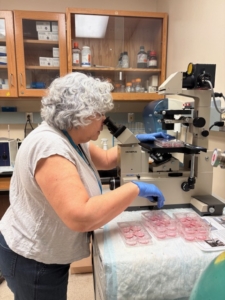
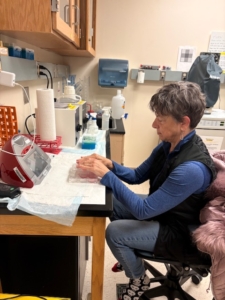
CRR director Patricia DeLeon (left), an Associate Professor of Biology and Nutrition at the Borough of Manhattan Community College, with assistance from CRR director Ann Thompson (right), a Certified Medical Reiki Master, is researching the impact of Reiki on the growth of human cancer cells.

Experimental Approach and Findings

The initial phase of the study consisted of three rounds of experiments, in which breast cancer cells received either Reiki or sham Reiki treatments. Across all three rounds, the results consistently showed that cells receiving Reiki exhibited reduced growth compared to the control group. Both Reiki and placebo groups displayed similar outcomes when treated with a single dose—15 minutes per day over three days. However, when the treatment frequency increased to two 15-minute sessions daily, a clear distinction emerged: the Reiki-treated cells demonstrated a more pronounced reduction in growth compared to those receiving the placebo. The latest set of experiments aimed to gather further statistical data, seeking a p-value of less than 0.05, and to assess the sustainability of Reiki’s effects over time.

Next Steps and Support 

Building on these promising results, the researchers plan to replicate the experiments using nematode C. elegans. This will allow the researchers to collect in vivo data and extend their findings beyond in vitro studies. Continued support is essential to keep this research moving forward. Help advance this important work and donate to CRR today.

Supporting Patient Care and Stress Management with Reiki at Duke University Hospital

After spending a decade in oncology nursing, Nicole Mouser recognized a critical need for integrative health practices. She now brings this vision to the inpatient bedside, utilizing holistic nursing theories and techniques — such as Reiki, mindfulness, EFT/tapping, and acupressure, among others — to support patient care and stress management.

Nicole Mouser RN, BSN, CSNIV, HNB-BC, HWNC-BC is a Board-Certified Holistic Health and Wellness Nurse Coach and Reiki Master Practitioner (RMT) with over 15 years of nursing experience. She currently serves as Stress Management Clinician for Duke University Hospital within the DUHS Advanced Practice Nursing department.

The 30-minute webinar will include a 10-minute live Q&A with the audience. All participants will receive a webinar recording, and all CRR associate and professional members will be automatically registered.

Register here.

All CRR past webinars may be purchased in video on demand format here.

CRR Paper Links Subjective Reiki Experiences to Changes in Physiological and Psychological Health

CRR, in collaboration with World Reiki Research and Harvard University, has just published the results of a landmark study evaluating whether specific subjective Reiki experiences are associated with changes in health-related symptoms using regression and mediation analyses. Ninety-nine Reiki practitioners had clients complete a survey before and after 1,284 Reiki (60-minute in-person) sessions.

Linear regression analyses explored associations between subjective Reiki experiences and changes in well-being, pain, and anxiety, while controlling for age and gender. Mediation models tested whether pain and anxiety changes mediated the relationship between subjective Reiki experiences and improvements in well-being.

Experiencing positive emotions was significantly associated with higher well-being and reduced anxiety, and experiencing such body sensations as tingling or warmth was significantly associated with greater pain relief. There was a significant indirect effect of body sensations on well-being via pain relief, a significant indirect effect of positive emotions on well-being via anxiety reduction, and a significant indirect effect of emotional release on well-being via anxiety reduction.

The results suggest that the subjective experience of receiving Reiki is related to changes in different psychological and physical health symptoms. More work is needed to confirm these findings while addressing the limitations of the current study.

This study is a novel contribution to biofield therapy research in several ways. First, it explores how Reiki works through specific psychological and physical pathways through employing a mediation analysis to quantify both indirect and direct effects, providing robust empirical support for the underlying mechanisms. Second, this study integrates both psychological (anxiety) and physical (pain) mediators, offering a more holistic understanding of Reiki’s effects. Third, it offers a framework to provide evidence for Reiki’s acceptance in clinical settings by linking subjective experiences to measurable changes in physiological and psychological health. Importantly, by identifying how Reiki may exert its effects (e.g., through pain relief or anxiety reduction), this analysis begins to answer the “why” question often missing in complementary and integrative medicine research. Understanding not only whether Reiki improves outcomes, but also how and why it does so, is central to advancing the evidence base for complementary and integrative medicine. Most prior Reiki research has demonstrated symptom improvements without clarifying the underlying processes. By employing mediation analysis, the present study provides a step toward explaining the why. When participants experience physical sensations (such as warmth or tingling), this is linked to reductions in pain, which in turn enhances overall well-being. Similarly, when participants experience positive emotions or emotional release, these appear to lower anxiety, which then improves well-being. In this way, the “how” is represented by the mediating pathways (pain relief, anxiety reduction), while the “why” lies in the role of subjective experience as the active ingredient that drives those changes. This shift from describing Reiki’s effects to explaining them is a step toward building evidence and integrating Reiki into broader models of health care.

Congratulations to the authors: CRR Research Assistant Elisenda Cama i Gibernau, CRR Director Akleema Ali and CRR President Natalie Dyer.

Read the paper here.

CRR Webinars Available in VOD Format


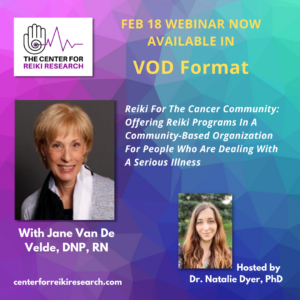
All CRR past webinars — including  Jane Van de Velde’s Reiki For The Cancer Community: Offering Reiki Programs To People Dealing With a Serious Illness — may be purchased in video on demand format here.

Past webinars are available at no charge to associate and professional members here.