Help Us Recruit 1,000 Reiki Practitioners
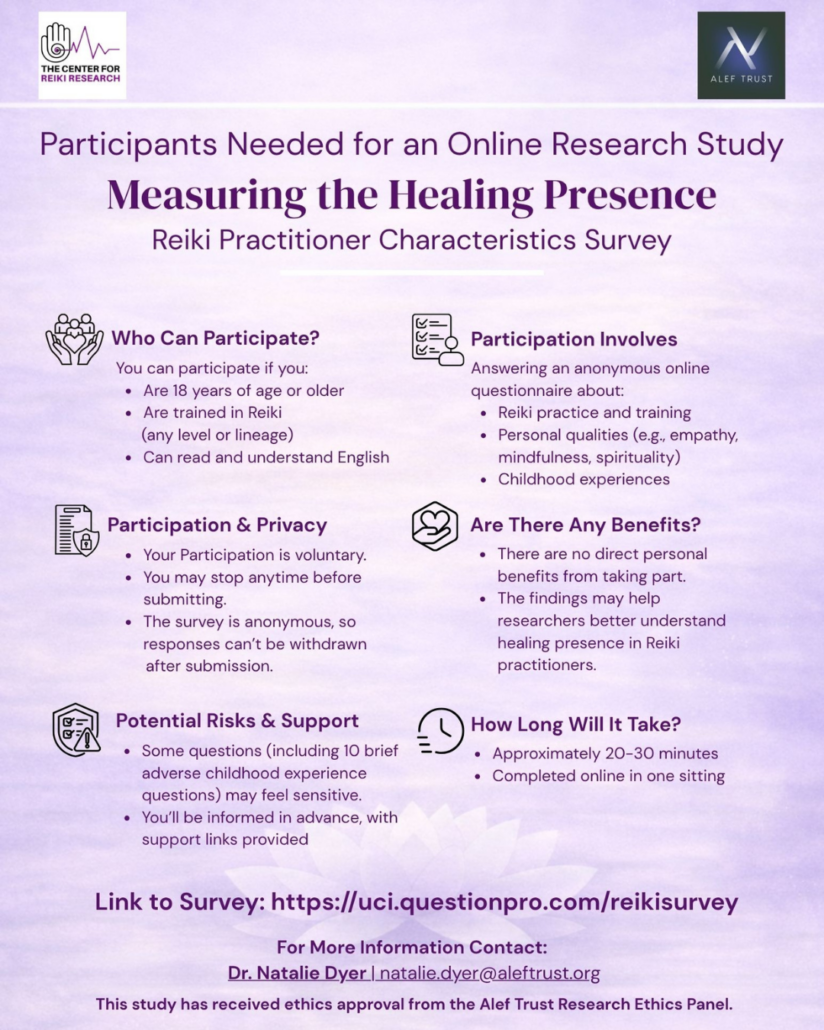
The Center for Reiki Research invites you to take part in a study to better understand the personal, psychological, and spiritual qualities that may contribute to what is described in the research literature as the “healing presence” in Reiki practitioners. Healing presence refers to a state of awareness and relational engagement through which a practitioner may support physical, emotional, and spiritual well-being in others. While previous research has primarily focused on the outcomes of Reiki treatments, relatively little research has examined the inner qualities and lived experiences of the practitioners themselves. This study seeks to explore qualities such as empathy, compassion, mindfulness, spirituality, intention, and transpersonal awareness, as well as early life and childhood experiences, using validated questionnaires and structured survey items. By examining these factors together, the study aims to contribute to a deeper understanding of how personal history and inner qualities may relate to healing presence in Reiki practice and to inform future research in this area.

If you choose to take part, you will be asked to complete a one-time anonymous online questionnaire, which will take approximately 20–30 minutes to complete. The questionnaire includes questions about your demographic background, Reiki training and practice experience, and a series of standardized questionnaires that assess characteristics related to healing presence, such as empathy, compassion, mindfulness, spirituality, universal love, and related experiences. The questionnaire also includes questions about early life and childhood experiences, including adverse childhood experiences. Examples of these questions include whether, during your first 18 years of life, you experienced situations such as feeling unsupported or unloved within your household, or whether a household member experienced mental health difficulties. In addition, the questionnaire includes items relating to noetic beliefs and experiences and extrasensory perception (ESP), including experiences that may occur during Reiki sessions or in everyday life, such as sensing emotions, receiving sudden knowledge or insight, or perceiving information beyond ordinary sensory channels.

There are no intended personal benefits associated with taking part; however, the findings may help the researchers in determining how personal history and inner qualities relate to healing presence in Reiki practitioners and may inform future research in this area.
Take the survey here. 

CRR Paper Links Subjective Reiki Experiences to Changes in Physiological and Psychological Health

CRR, in collaboration with World Reiki Research and Harvard University, has just published the results of a landmark study evaluating whether specific subjective Reiki experiences are associated with changes in health-related symptoms using regression and mediation analyses. Ninety-nine Reiki practitioners had clients complete a survey before and after 1,284 Reiki (60-minute in-person) sessions.

Linear regression analyses explored associations between subjective Reiki experiences and changes in well-being, pain, and anxiety, while controlling for age and gender. Mediation models tested whether pain and anxiety changes mediated the relationship between subjective Reiki experiences and improvements in well-being.

Experiencing positive emotions was significantly associated with higher well-being and reduced anxiety, and experiencing such body sensations as tingling or warmth was significantly associated with greater pain relief. There was a significant indirect effect of body sensations on well-being via pain relief, a significant indirect effect of positive emotions on well-being via anxiety reduction, and a significant indirect effect of emotional release on well-being via anxiety reduction.

The results suggest that the subjective experience of receiving Reiki is related to changes in different psychological and physical health symptoms. More work is needed to confirm these findings while addressing the limitations of the current study.

This study is a novel contribution to biofield therapy research in several ways. First, it explores how Reiki works through specific psychological and physical pathways through employing a mediation analysis to quantify both indirect and direct effects, providing robust empirical support for the underlying mechanisms. Second, this study integrates both psychological (anxiety) and physical (pain) mediators, offering a more holistic understanding of Reiki’s effects. Third, it offers a framework to provide evidence for Reiki’s acceptance in clinical settings by linking subjective experiences to measurable changes in physiological and psychological health. Importantly, by identifying how Reiki may exert its effects (e.g., through pain relief or anxiety reduction), this analysis begins to answer the “why” question often missing in complementary and integrative medicine research. Understanding not only whether Reiki improves outcomes, but also how and why it does so, is central to advancing the evidence base for complementary and integrative medicine. Most prior Reiki research has demonstrated symptom improvements without clarifying the underlying processes. By employing mediation analysis, the present study provides a step toward explaining the why. When participants experience physical sensations (such as warmth or tingling), this is linked to reductions in pain, which in turn enhances overall well-being. Similarly, when participants experience positive emotions or emotional release, these appear to lower anxiety, which then improves well-being. In this way, the “how” is represented by the mediating pathways (pain relief, anxiety reduction), while the “why” lies in the role of subjective experience as the active ingredient that drives those changes. This shift from describing Reiki’s effects to explaining them is a step toward building evidence and integrating Reiki into broader models of health care.

Congratulations to the authors: CRR Research Assistant Elisenda Cama i Gibernau, CRR Director Akleema Ali and CRR President Natalie Dyer.

Read the paper here.

Advocating for Scientific Rigor in Reiki Research

As part of CRR’s efforts to promote scientific rigor in Reiki research, we’ve successfully connected with the scientific journals Epilepsy & Behavior, Journal of Paediatrics and Child Health, and Journal of Nursing and Education.

CRR director Ann Baldwin authored three letters to the editors, referencing Biofield Therapies: Guidelines for Reporting Clinical Trials which outlines the steps required to produce scientifically sound research papers. Since the guidelines are applicable to designing studies as well, CRR recommended the three journals augment their “Instructions for Authors” with a copy of, or reference to, these guidelines.

All three letters have been published:

CRR’s mission is to validate and foster the acceptance of Reiki biofield therapy as an integrative healthcare practice. Only rigorous, scientifically robust studies can provide the evidence necessary to support the use of this low risk, non-invasive modality in clinical settings.

A Survey of Integrative Health Therapies in the United States Healthcare System

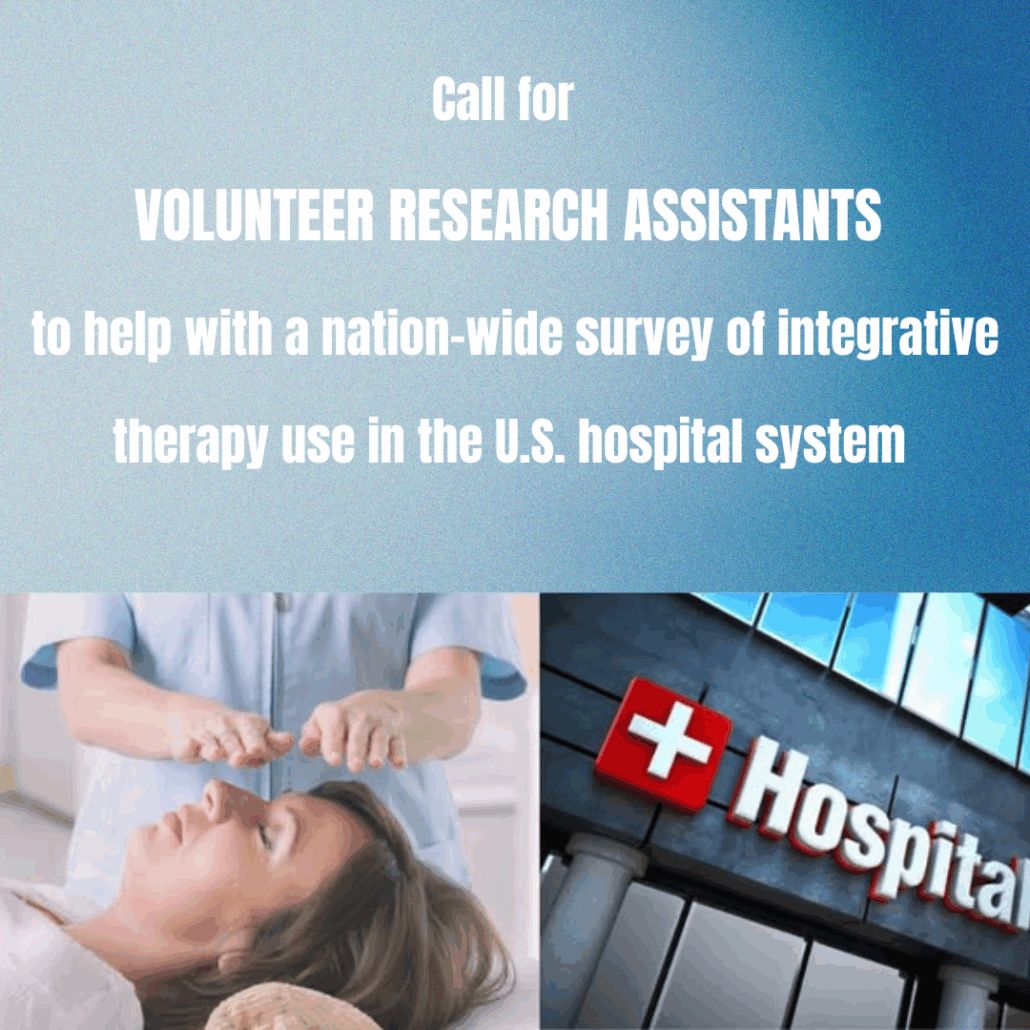
We are looking for volunteer research assistants (RAs) to help with a nation-wide survey of integrative therapy use in the U.S. hospital system. RAs will assist with data collection, including obtaining appropriate hospital contacts, conducting telephone calls with hospital staff, and inputting data.

Responsibilities:

  • Obtaining appropriate hospital contact information
  • Contacting hospitals through phone and email
  • Speaking in a courteous manner to all hospital staff
  • Following a script in a natural way
  • Recording information accurately in Word and Excel
  • Use of online software to input data

Skills and Qualifications:

  • Highly experienced with Microsoft Office including Word and Excel
  • Customer service skills; courteous and polite
  • Ability to speak and understand English
  • Data entry skills, accuracy is essential
  • Ability to work well within a team and independently
  • Access to the Internet and ability to make telephone calls through the United States
  • Connections/working within the US healthcare system is an additional asset
  • Background in research methodology, data analysis and publication a strong additional asset
  • Human subjects training (CITI program) is also an asset but not required

Time commitment: A minimum of 5 hours per week for up to 9 months. Includes one biweekly team meeting and time surveying hospitals.

Benefits: Contribute to integrative medicine research. Receive acknowledgement in the scientific publication and potential opportunities for co-authorship depending on skills and experience.

If you are interested, please send your cover letter and CV to Natalie Dyer at dyern@uci.edu

woman receiving Reiki with non-physical beings in the background

Latest Thought-Provoking Reiki Papers Available For All

woman receiving Reiki with non-physical beings in the background
In addition to our invaluable research summaries, available to associate and professional CRR members, we also regularly post interesting papers of value that do not fit CRR’s evaluation criteria for a research summary on the articles page.

Freely available to all, the latest papers include:
  • Reports of Non-Physical Beings Assisting in Reiki Sessions by Helané Wahbeh
  • Reiki in Digital Art Therapy: Interdisciplinary Practice in the Fourth Industrial Revolution by Yiu Kwong Au-Yeung, and
  • Reiki Initiations and the Role of Expectations Key Points by Graziano Scarascia.
CRR is 100 percent independent and funded solely by memberships and donations from people like you so please consider donating today or becoming an associate or professional member.
calm dog receiving Reiki

Clinical Applications Of Reiki In Dogs And Cats

Available on our web site, The Use of Reiki in Companion Animal Care: A Review of Its Applications in Dogs and Cats examines Reiki’s therapeutic potential and ethical considerations, and contributes to the growing discourse on holistic approaches in veterinary medicine, advocating for an inclusive model that embraces both conventional and alternative therapies.

For those interested in Reiki for animals, a reminder not to miss Veterinarian Claudia Barbieri’s oral presentation The Impact of Distant Reiki on Owner Assessment of Health and Well-Being in Adult Dogs: A Blinded, Placebo-Controlled, Randomized Trial at the International Reiki Research Conference on October 4th. (Single day conference registrations are available.)

Register for the conference here.

Can Reiki Research Shape Future Healthcare

In this illuminating conversation, Beyond the Reiki Gateway host Andrea Kennedy sits down with Dr. Natalie Dyer — research scientist, Reiki Master, and President of the Center for Reiki Research — to explore the evidence behind energy healing and its place in the future of healthcare, and discuss the upcoming International Reiki Research Conference October 4-5, 2025.

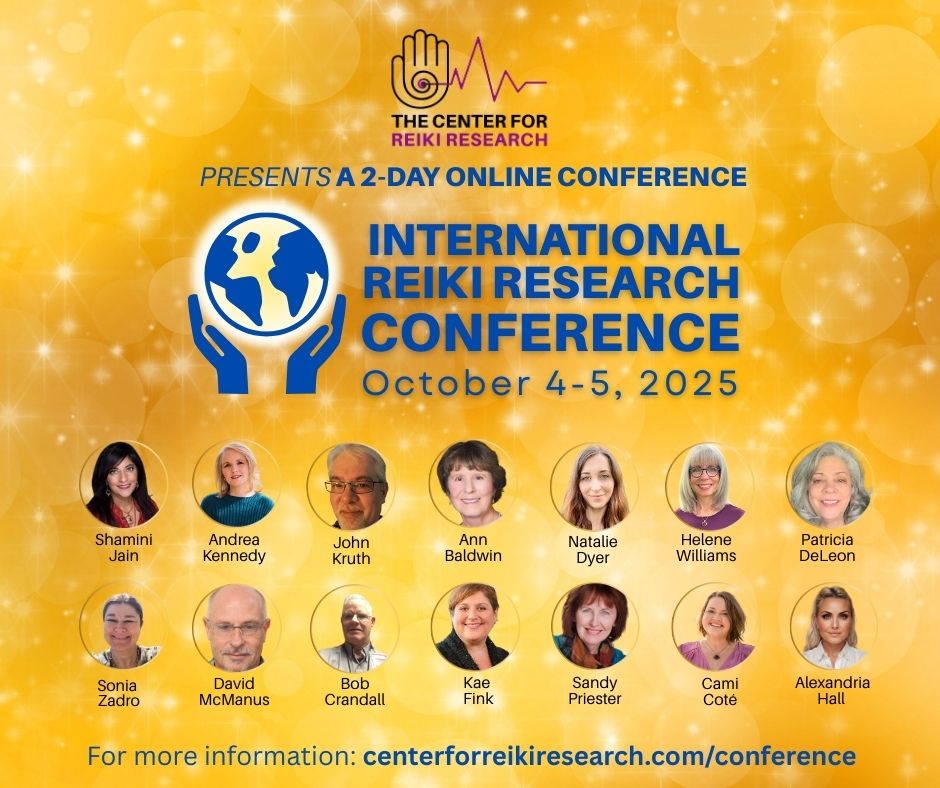
Int’l Reiki Research Conference Preliminary Program


Explore advances in Reiki research and be inspired by successful Reiki programs in healthcare settings during the virtual International Reiki Research Conference (IRRC) on October 4th and 5th, 2025. Hosted by the Center for Reiki Research, IRRC is the only conference focused solely on Reiki research.

Check out these conference program highlights:
🔹Keynote speaker Dr. Shamini Jain with From Chaos to Coherence: Biofield Science and Why Healers Lead the Future.
🔹Plenary speaker John Kruth on Enlightened Healing Research.
🔹Plenary speaker Ann Baldwin with Reiki Research — Aiming High.
🔹Guided meditations by Andrea Kennedy, Alexandria Hall, and Cami Coté.
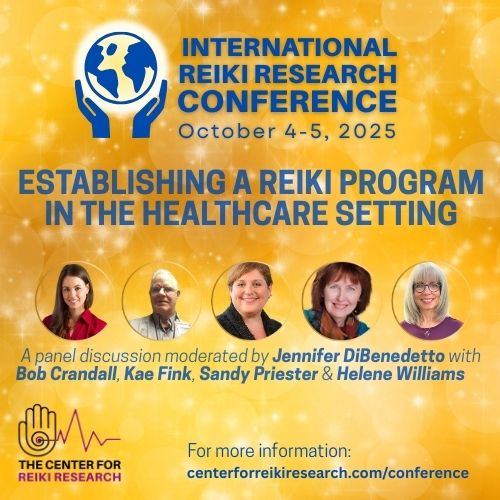
🔹Panel discussion on Establishing a Reiki Program in the Healthcare Setting with Bob Crandall, Kae Fink, Sandy Priester, Helene Williams and Jennifer DiBenedetto.
🔹Panel discussion on Reiki and Placebo: Healing, Belief and Science in Dialogue with Patricia DeLeon, Natalie Dyer, Sonia Zadro, David McManus and Ann Baldwin.
🔹Oral presentations on wide-ranging research from Reiki for Parkinson’s disease and the impact of distant Reiki on adult dogs to the lived experiences of women healers.

Register here.

Establishing a Reiki Program in the Healthcare Setting

Just seven weeks until the International Reiki Research Conference!

We are pleased to announce the Establishing a Reiki Program in the Healthcare Setting panel discussion on October 4th.

This panel will discuss approaches to bringing Reiki into the healthcare setting for both patients and healthcare staff, including how to conduct research of the program. Successes and challenges will be explored, providing guidance for healthcare workers, researchers, and Reiki practitioners interested in bringing Reiki into hospitals.

Panelists Kae Fink, Helene Williams, Bob Crandall, and Sandy Priester bring a wealth of knowledge and experience to this topic from diverse perspectives.

Moderated by Dr. Jennifer DiBenedetto.

Register here.